
Deck Cadet Jobs at Sea: Verified Maritime Vacancies with Salary and Joining Dates
Deck Cadet Jobs at Sea: Verified Maritime Vacancies with Salary and Joining Dates
By Michael Thompson
Deck Cadet Jobs at Sea: How to Find, Evaluate and Land a Maritime Vacancy
Every year, thousands of young people decide that a life at sea is the career they want, and the first real obstacle they face is not the ocean but the job market itself. Searching for deck cadet vacancies sounds simple until you realise that postings come from dozens of crewing agencies, shipowners and manning offices, each with different standards, different salary structures and different promises about joining dates. SeaJobs.pro was built to bring many of these current postings into one place, showing the salary, vessel type and joining date for each one so that a cadet can compare offers before committing any money or personal documents. This article explains how the deck cadet role actually works, what employers expect, how to read a vacancy correctly, and how to protect your career while you are still building sea-time.
The deck cadet is a trainee deck officer. The position exists for one purpose: to accumulate the supervised sea-time, practical skills and documented experience that allow a cadet to sit for a certificate of competency and eventually stand a watch as a qualified officer. That makes the cadet’s job different from that of an ordinary deck rating. A rating performs tasks; a cadet is expected to learn why those tasks are done, to follow the officer of the watch, and to record every hour in a form that will later be accepted by a maritime administration. When you read a posting, the word “cadet” tells you as much about the training commitment of the employer as it does about the position itself.
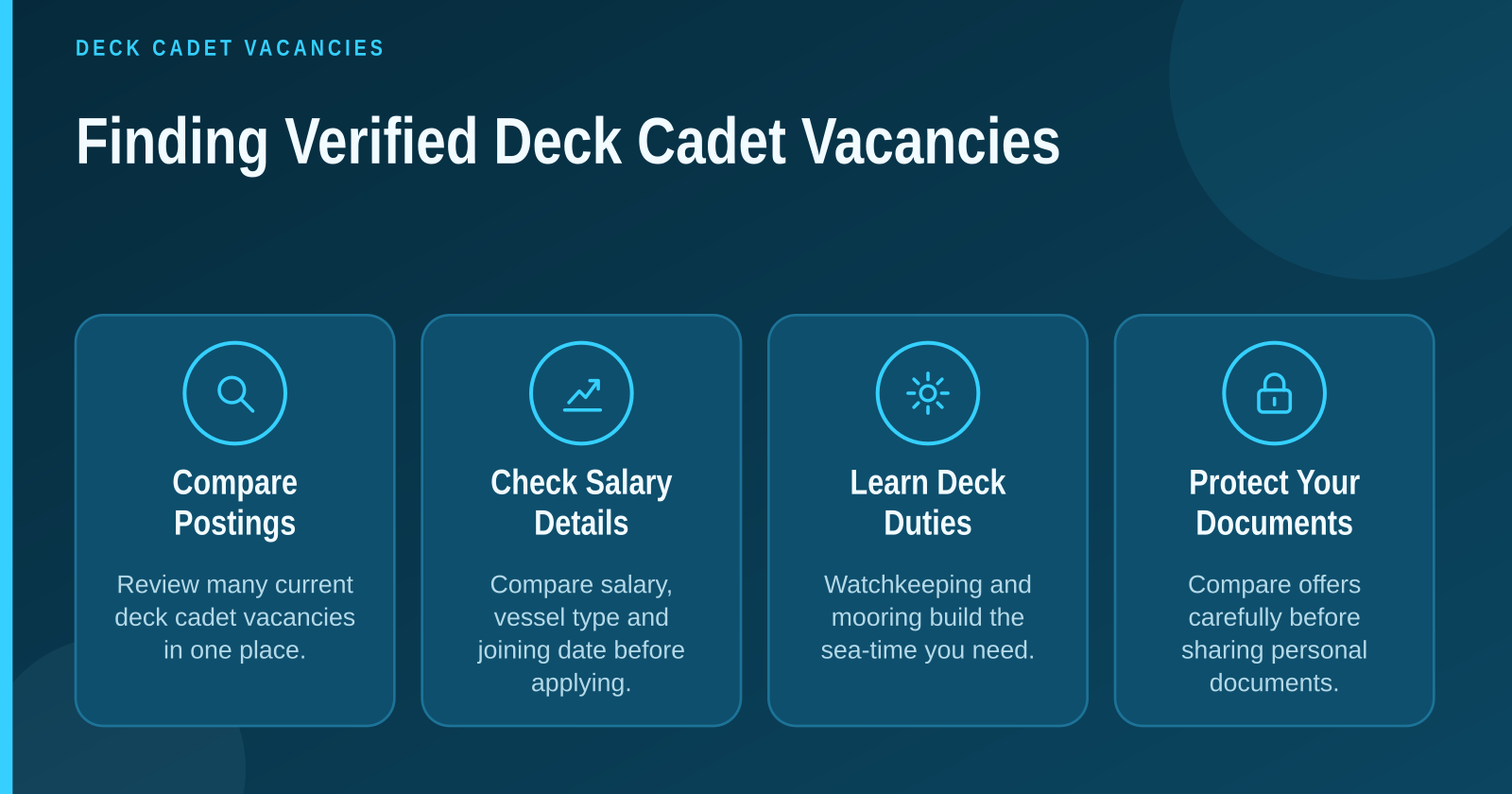
- The platform lists the salary, vessel type and joining date for each posting, which gives cadets the core facts needed for an initial comparison before they invest time in an application
- This removes the need to pay intermediaries simply to send an application and makes it easier to respond quickly when a suitable position appears
- Check the agency’s standing with the relevant maritime authority, confirm the operator and flag of the vessel, and ask for the full contract before you commit
- Learn to recognise the difference between a verified agency, a direct operator and a fraudulent offer
What a Deck Cadet Actually Does Onboard
On a typical day, a deck cadet works within the deck department under the direction of the chief officer and the second officer. Watchkeeping is the core of the role. A cadet stands watches on the bridge under supervision, learns to keep a proper lookout, takes the helm when instructed, and gradually begins to understand how the ship responds to rudder, engine and weather. Many cadets remember their first night watch as the moment the job stopped being a set of tasks and became a responsibility. The supervision is not a formality; it is the mechanism through which the ship’s officers verify that you are ready for the next step.
Outside the bridge, the deck cadet spends considerable time on mooring operations, cargo and ballast work depending on the vessel type, and routine deck maintenance such as chipping, painting, cleaning and inspection of equipment. These tasks may look physically demanding and unglamorous, but they teach the practical knowledge that examiners will later test: how lines are rigged, how a winch is inspected, how cargo tanks are prepared, and how safety equipment is maintained. A cadet who treats the maintenance work as a learning opportunity, asking why each procedure exists, usually progresses faster than one who simply completes the list.
The most important administrative duty is the logging of sea time. Every watch, every supervised task and every drill has to be recorded in a form accepted by the flag state or the competent authority that will evaluate your certificate application. This is where many cadets run into trouble later. Sea-time that is poorly documented, signed inconsistently or recorded against the wrong vessel type can be disputed, and in some cases a cadet discovers only during the examination process that months of work do not count. Keeping a disciplined training record from the first day is one of the most valuable habits a cadet can build.
It is also worth understanding the difference between a cadet, a trainee and a junior rating, because job titles vary between vessel types and operators. On a large container ship or bulk carrier, the cadet may be part of a formal training structure with an assigned training officer. On an offshore support vessel or a smaller coastal ship, the same title may describe a person who spends more time on general deck work with less structured instruction. Neither arrangement is automatically better, but the difference determines how much countable training you will receive, and a posting that uses the word “cadet” does not guarantee that structure exists. You need to check.
Entry Requirements and Documentation
The minimum formal requirements for a deck cadet are set largely by the STCW Convention, which establishes the basic safety training that every seafarer must hold. In practice, this means completion of the basic safety courses, which typically include personal survival techniques, fire prevention and firefighting, elementary first aid and personal safety and social responsibilities. Along with these certificates you will need a valid seafarer’s medical fitness certificate issued by a doctor approved by your national authority. Agencies will not submit a candidate profile without these documents, and a medical that is close to expiry can delay a contract by weeks.
Beyond certification, you need a seaman’s book or equivalent identity document, a passport with adequate validity (many countries require at least six months beyond the planned contract period), and an awareness of visa requirements. Crews on international vessels are multinational, and a cadet joining a ship in a foreign port may need a transit or crew visa before a flight can even be booked. Ask the agency early whether they handle visa support or whether you must arrange it yourself, because this difference alone can change the timeline from application to joining by a significant margin.
Age limits, education prerequisites and sponsorship are where requirements vary most. Some operators accept applicants who have completed secondary education and hold a basic safety certificate; others expect a maritime academy diploma or a recognised training programme. A number of cadet programmes are linked to maritime academies, where the academy places students with shipowners for their sea phase and the company may sponsor part of the training costs in exchange for a commitment to employ the graduate. If you are considering this route, read the sponsorship terms carefully, because the obligations on both sides are often more detailed than the brochure suggests.
The documents that agencies usually request before submitting a profile typically include a current CV with a clear record of any prior sea-time, copies of certificates, the medical certificate, passport details, and sometimes references from previous employers or training institutions. Prepare these in advance as scanned, legible files. Candidates who arrive with incomplete or unreadable documentation are often moved to the back of the queue, not because the agency is strict, but because the crewing manager has a vessel waiting and a limited window to fill the position.
Where Deck Cadet Vacancies Come From and How Recruitment Channels Differ
Understanding where a vacancy originates is as important as the vacancy itself. Most cadet positions reach job seekers through one of three routes: a manning agency acting on behalf of a shipowner, a shipowner or ship manager hiring directly, or a training institution placing its own graduates. Each route has different implications for pay, contract stability, training quality and the number of intermediaries between you and the employer. Learning to recognise the route behind a posting helps you ask better questions before you send anything.
Verified Crewing Agencies versus Direct Shipowner Hiring
Crewing agencies source, screen and place seafarers on behalf of shipowners. A reputable agency performs document checks, arranges medicals where needed, coordinates contracts and handles travel. For a cadet who is new to the industry, this can be a genuinely useful service, because the agency often knows which operators have active training programmes and which ones are simply looking for cheap labour. The agency’s placement fee is usually paid by the employer, but some agencies charge candidates directly for administrative or training-related services. Whether that is legitimate depends on the jurisdiction and the nature of the fee, so always ask for a written breakdown.
Direct recruitment by an operator usually offers more transparency about the training structure. When a shipowner hires a cadet directly, the cadet is typically part of the company’s own system, with a named training officer, a documented programme and clearer lines of responsibility if something goes wrong. Contract stability can also be stronger, because the cadet has a relationship with the company rather than a chain of intermediaries. The trade-off is that direct hiring positions are often more competitive, and operators may prefer candidates who have already been recommended through their academy or an existing crew member.
There are red flags in agency arrangements that every cadet should learn to spot. The most serious is any request for upfront payment before a contract has been signed, particularly if the amount is described as a “processing fee” or a “guarantee deposit” with no clear refund terms. Legitimate agencies do not usually ask candidates to pay for a job offer. Other warning signs include vague company names, a refusal to provide the name of the principal shipowner, pressure to accept an offer within hours, and contracts that are sent only after payment has been made. If an offer seems too good to be true in salary or joining speed, pause and verify before proceeding.
A well-run agency will tell you the name of the vessel, the operator, the flag and the trading area before you commit. If that information is withheld, the risk sits with you.
Reading a Vacancy Posting Correctly
A posting is a summary, and the details that matter most are often the ones left out. The first thing to check is what the salary figure actually represents. A monthly figure quoted as “from 800 EUR” may refer to a basic wage, with overtime, leave pay, allotments and bonuses added separately, or it may be an all-inclusive figure. Some postings show a wage that excludes social security contributions, tax or agency deductions. Before comparing two offers, establish whether each figure is gross or net, basic or total, and what the contract says about overtime calculation and paid leave.
The vessel type and trading area are predictors of both workload and the value of your sea-time. A bulk carrier on regional trades will usually involve a different rhythm from a liquefied gas carrier or a car carrier on long-haul routes. Tankers, particularly chemical and gas carriers, often involve stricter safety regimes and specialised cargo procedures, which can be excellent for a cadet who wants to build a technical profile but more demanding in terms of workload and supervision. Container ships may offer frequent port calls and mooring experience but shorter port stays. None of these is inherently better; the question is which one matches the certificate and career direction you have in mind.
Joining date windows and rotation length are equally important. A posting that says “to be confirmed” may mean the vessel is still being fixed for a charter, or that the agency has not yet secured a confirmed date, and it can mean weeks of waiting with no income. Ask for the expected joining port, the rotation pattern (for example, a set number of months on board followed by leave), and whether the contract begins from the date of joining or from the date of leaving home. These definitions affect how much you are actually paid for time spent travelling and waiting.
How to Evaluate and Compare Offers: Selection Criteria That Matter
Once you have a shortlist of vacancies, the next task is comparison. Most cadets are tempted to choose the highest monthly figure, and that is often a mistake. A better approach is to evaluate each offer against four criteria: training quality, contract terms, the operator’s safety and compliance record, and the practical details of joining. Each criterion can be checked, and each one reveals something that the headline salary hides.
Training Quality and Sea-Time Value
The most important question for a deck cadet is whether the placement will generate countable sea-time that will be accepted toward your certificate of competency. Ask whether the vessel has an assigned training officer, whether the operator runs a documented cadet programme, and whether there is a training record book or equivalent that will be reviewed by the company or by an examiner. A ship where the cadet is expected to learn from a senior officer who has time to teach is worth far more than a ship where the cadet is treated as extra hands.
The type of ship also determines the training yield. Bulk carriers provide strong experience in cargo handling, hatch operations and ballast management, along with a lot of mooring work. Tankers expose the cadet to cargo, pumping and tank procedures and to a high level of safety discipline. Container ships offer intensive mooring and lashing work and a fast operational pace. Offshore and passenger vessels bring their own specialised duties, from dynamic positioning to passenger safety. Choose the ship type that aligns with the certificate you are pursuing and the competencies your future employers are likely to value.
A simple checklist can help you judge whether a placement will count. Confirm the vessel’s flag and whether that flag’s administration accepts the sea-time under your certificate pathway. Confirm that the operator provides a signed sea-service record. Ask whether the cadet will keep a logbook of supervised watches and tasks. Ask how the company assesses cadet progress and whether there is a mid-contract review. If the answers are vague, the placement may still be valuable, but you should assume that you will need to do more documentation work yourself.
Contract Terms, Compensation and Welfare
Contract length and rotation schedule shape your daily life as much as your income. A contract of four months on and two months off suits some people and frustrates others. Read the repatriation clause carefully: it should state who pays for your return travel, under what circumstances, and within what time frame. Repatriation guarantees matter most when a contract ends early for reasons outside your control, such as the sale of the vessel or a medical issue, and they are one of the first things that badly managed operators tend to get wrong.
Insurance coverage, medical provision and the status of any collective agreement are the next layer. Check whether the contract includes personal accident and medical insurance, and whether the coverage extends to shore leave and travel. Find out whether the vessel is covered by an agreement negotiated by a seafarers’ union, because such agreements often set minimum standards for wages, overtime and welfare that are enforceable. If there is no collective agreement, the contract becomes the only protection, and it deserves more careful reading.
Compensation should be compared as total compensation rather than as a headline monthly figure. Two offers with the same basic wage can differ significantly once you account for overtime rules, leave pay, travel allowances, bonuses and deductions. Build a simple spreadsheet that lists the basic wage, guaranteed overtime, leave pay, expected allotments, and any deductions for agency fees or insurance. This exercise often reveals that a lower-paying contract with better welfare and training is the stronger option over the full period. Those who are considering this path can compare current deck cadet vacancies on SeaJobs.pro, paying attention to the vessel type, the trading area, and whether the company offers a structured training programme.
Flag State, Operator Reputation and Safety Record
The flag state under which a vessel sails affects its regulatory oversight, inspection regime and the recognition of your sea-time. Check the flag’s standing on international lists and whether it has a good record of compliance with conventions. Port state control results are publicly available for many regions and offer a practical view of how a vessel has performed in recent inspections. Repeated detentions, serious deficiencies in safety equipment or poor crew accommodation are signals that deserve attention before you accept a contract.
Operator reputation can be assessed through several channels. Ask the agency for the name of the company that manages the vessel, then look for independent information about its fleet, its certificates and its record with inspectors. Crew feedback is valuable but must be interpreted with care, because a single unhappy former crew member does not establish a pattern. Look for consistent themes across multiple sources, including comments about pay reliability, training commitment and how the company handles complaints. A company that welcomes questions from candidates is usually more trustworthy than one that discourages them.
Step-by-Step Application Process and Realistic Timelines
An organised application process reduces wasted effort and protects you from the most common delays. The sequence is usually the same across agencies and operators: profile preparation, application, screening, interview, medical confirmation, contract review and signing, travel arrangements and finally joining the vessel. Knowing what happens at each stage lets you prepare documents in advance and avoid losing time when a crewing manager asks for something urgently.
Preparing Your Profile and Documents
A cadet CV should be factual, concise and easy to verify. List your education, your basic safety certificates with their issue and expiry dates, your medical fitness status, any previous sea-time with vessel names, types, flags and dates, and any relevant shore-based experience such as work on boats, ports or in maritime training. References from teachers, training providers or previous employers add credibility, especially for a candidate with limited sea-time. Avoid padding the CV with irrelevant detail, because crewing managers scan many applications quickly and reward clarity.
Prepare a document checklist and keep digital copies organised in one folder. Typical items include the passport data page, seaman’s book, certificates, medical certificate, proof of education, reference letters and a recent passport-style photograph. Common gaps that delay onboarding include expired medicals, certificates with a short remaining validity, passports that will expire soon after the planned contract, and missing signatures on sea-service records. Check each item against the expiry dates and the requirements of the flag state before you apply.
From Application to Joining: What to Expect
After you apply, the screening stage typically checks that your documents meet the minimum requirements and that your profile matches the vacancy. Some agencies will call for a brief phone or video interview to confirm your motivation, English level and understanding of shipboard life. The interview is usually not technical at cadet level, but you should expect questions about why you want a career at sea, how you handle long periods away from home, and how you respond to supervision and criticism.
If you are selected, the agency or operator will usually arrange a medical examination where the existing certificate is not sufficient, followed by the contract review. Read the contract thoroughly before you sign, and ask for clarification on any clause you do not understand. Once signed, travel arrangements are made, which can include flights, visas and transfers to the joining port. Realistic timelines from first application to first day onboard vary widely. A candidate with complete documents and a vacancy that is already confirmed may join within a few weeks, whereas a candidate who needs a new medical or a visa may wait considerably longer.
Following up without damaging your candidacy is a skill in itself. A short, polite message after a reasonable interval is appropriate, particularly if the agency gave you a date that has passed. Avoid repeated calls on the same day, and do not contact multiple recruiters with the same wording as if you had not applied elsewhere. Keep a simple log of who you applied to, when, and what was promised, so that your communication stays consistent and professional.
Common Mistakes Cadets Make and How to Avoid Them
Most cadets who struggle in their first years do not fail because the job is too hard. They fail because of avoidable decisions made early, often under pressure to join quickly. The two most damaging categories of mistake are financial and contractual, and career and certification. Recognising them in advance lets you protect both your money and your future qualifications.
Financial and Contractual Pitfalls
Paying unofficial fees is one of the fastest ways to lose money with nothing to show for it. Be wary of any request for payment to secure a position, to “expedite” documents, or to cover costs that the employer normally bears. Legitimate costs such as your own medical examination or the fees for statutory certificates are usually clearly defined and receipted. Fraudulent job offers often mimic real agencies, use professional-looking emails and even fake contracts, so verify the company independently by contacting the employer through contact details you have found yourself rather than those supplied in the message.
Misreading contract clauses on wages, deductions and termination is the second major pitfall. Pay particular attention to how overtime is calculated, whether leave pay is included in the monthly figure, what deductions are made for accommodation or food, and under what conditions the employer can terminate the contract. A clause that allows early termination without repatriation or without payment for the notice period can leave you stranded. If you are unsure about any clause, seek independent advice from a seafarers’ welfare organisation or a maritime lawyer before signing.
Career and Certification Pitfalls
Choosing placements that do not generate countable sea-time is a serious long-term mistake. A cadet who spends a year on a vessel whose flag, operator or duties do not meet certificate requirements may find that the year has to be repeated. Before accepting a placement, confirm with your training institution or the relevant maritime administration that the type of vessel, the trading area and the supervisory arrangements will count toward your examination pathway. A short conversation at the start can save years of frustration.
Gaps in documentation that delay certificate examinations are another common problem. Cadets sometimes keep their sea-service records informally, with missing signatures, unclear dates or incomplete descriptions of duties. When it is time to apply for an examination, these gaps can require lengthy correction. Treat your training record as a professional document from the first day, update it regularly and ask the officer responsible to sign each entry when the task is completed.
Ignoring the role of mentorship in long-term career progression is the final error. Cadets who find a senior officer willing to teach, explain and assess them usually develop faster and gain better references for future positions. Mentorship does not happen automatically; it grows from showing interest, asking good questions, completing tasks reliably and being honest about what you do not yet understand. Those relationships often become the basis for promotion, recommendations and access to better vacancies later in your career.
How SeaJobs.pro Supports Deck Cadets in Finding and Applying for Vacancies
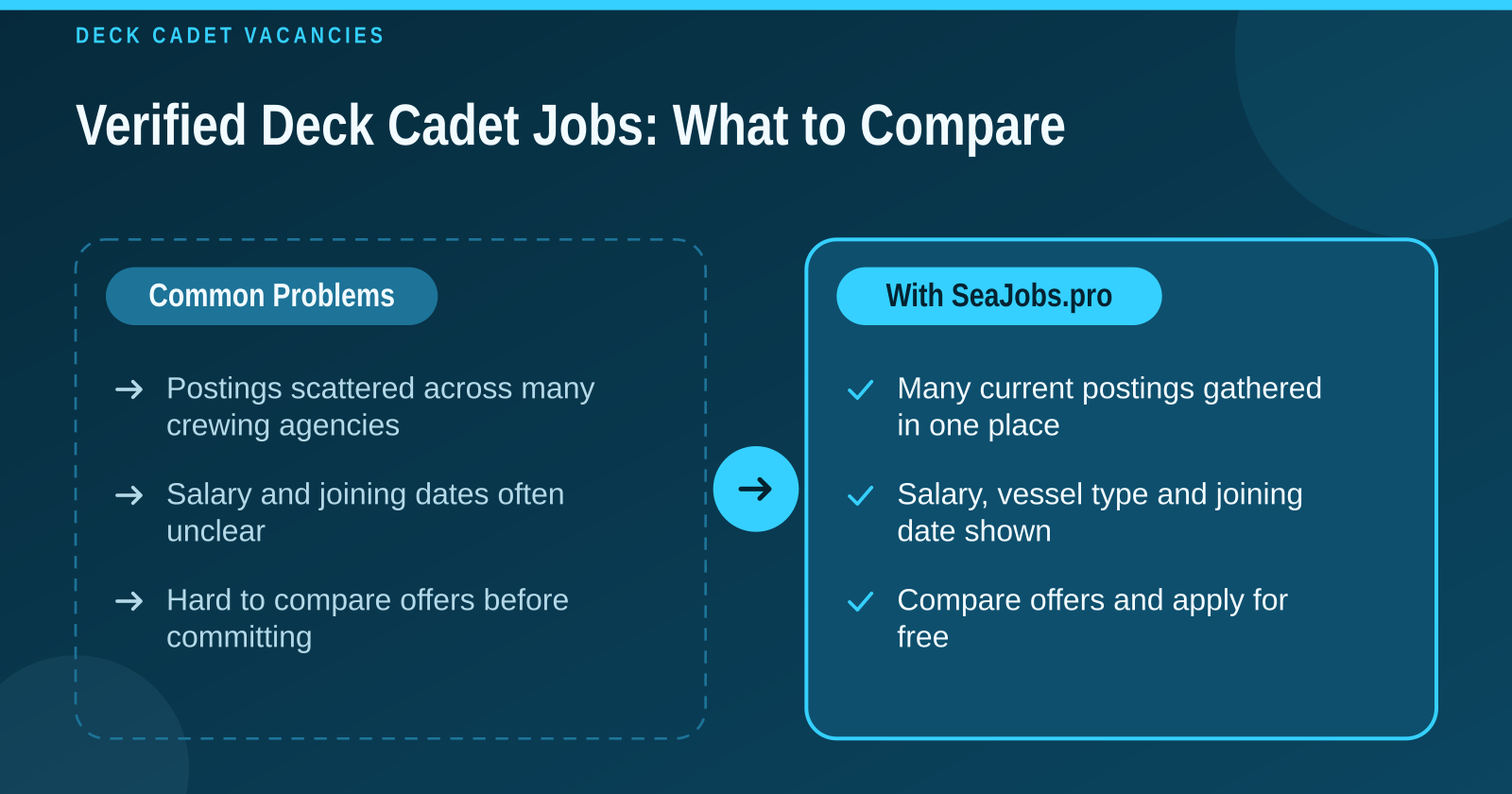
For a cadet at the start of the job search, the greatest challenge is often fragmentation: postings scattered across agency websites, social media groups and word of mouth, with inconsistent information. SeaJobs.pro addresses part of that problem by consolidating current deck cadet postings from verified crewing agencies in one place, so that job seekers can review opportunities side by side rather than tracking them across many sources.
The platform also allows applications to be submitted free of charge, with your CV going directly to the crewing manager responsible for the vacancy. Keeping track of which vacancies you have applied for and what responses you receive is then a matter of discipline, and a clear record of this kind is useful when you need to follow up.
Even with a well-organised platform, some responsibilities remain with the candidate. You should verify every offer independently before paying anything or sharing sensitive documents, and you should never treat a listing as proof that the employer is legitimate. Finally, match each posting to your personal certification goals and sea-time requirements. A vacancy that looks attractive on salary alone may be the wrong fit for the certificate you are working toward, and only you can judge that.
Conclusion: Building a Career One Verified Vacancy at a Time
A deck cadet position is more than a first job at sea. It is the opening stage of a qualification that will shape your working life for decades, and the decisions you make about where to apply, which offers to accept and how to document your training will determine how smoothly that qualification comes. The best cadets treat the search as a professional process: they understand the role, they prepare their documents in advance, they read postings for what they really say, and they compare offers on training value, contract protection and safety record rather than on the headline salary alone.
The practical steps are clear. Build a clean and verifiable CV and document set before you apply. Read every contract line by line, and keep a disciplined record of your sea-time from the first watch. Use platforms such as SeaJobs.pro to see current deck cadet vacancies from verified crewing agencies, including salary, vessel type and joining date, and then do your own verification before taking the next step. Careful choices made early will protect both your income and your certification, and they will make the difference between a cadetship that quietly builds a career and one that stalls for reasons that could have been avoided.